
CHICAGO GARBAGE TRUCK ACCIDENT Lawyer
PRACTICE AREAS
A Chicago garbage truck accident lawyer helps victims injured or families of loved ones killed by refuse, recycling, and dump trucks recover compensation for medical bills, lost income, pain and suffering, and other losses. For accidents involving garbage trucks or waste management trucks, the City of Chicago, a private owner, truck driver, maintenance provider, manufacturer, or combination may be at fault. The deadline for filing garbage truck accident claims can be as short as one year, so retaining legal counsel quickly is crucial.
To schedule a free consultation with a Chicago truck accident attorney, call 312-321-1111. Our law firm handles personal injury cases on a contingency-fee basis; you don’t pay anything unless we win.
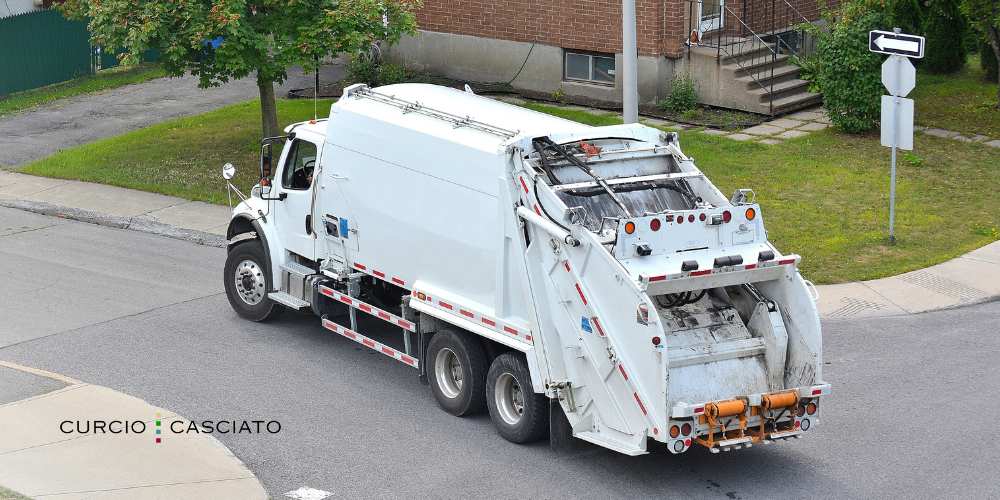
Common Causes of Dump Truck & Garbage Truck Accidents in Chicago
Personal injury cases involving refuse and dump trucks typically include more severe injuries. Construction vehicles and garbage trucks pose some of the more dangerous hazards, particularly in downtown Chicago: constant stop-and-go collection, wide blind spots, heavy and shifting cargo, tight residential and alley routes, and frequent reverse maneuvers around pedestrians and other vehicles.
Our Chicago garbage truck accident attorney team sees the same operational hazards in many cases.
Common causes of dump truck and garbage truck crash cases:
- Blind-spot collisions: large no-zones on the sides and rear hide cyclists, pedestrians, and smaller vehicles
- Unsafe backing and reversing: garbage truck drivers failing to use a spotter
- Sudden and frequent stops: rear-end and sideswipe crashes as trucks halt mid-block
- Distracted driving: drivers distracted by route tablets, radios, and phones divert attention
- Fatigued driving: garbage truck drivers on long shifts and early-morning routes
- Overloaded or improperly loaded trucks: heavy loads or shifting weight lengthen stopping distance and raise rollover risk
- Inadequate maintenance: worn brakes, tires, and hydraulics on high-mileage fleet vehicles
- Falling or flying debris: uncovered or overfilled loads
- Wide and illegal turns: long wheelbases swing into adjacent lanes and crosswalks
- Negligent hiring: hiring without adequate driver qualifications, licensing, or experience to operate heavy loads in congested traffic or construction sites
- Other truck driver errors: reckless driving, drunk driving, aggressive driving, speeding, etc.
Dump truck and garbage truck drivers/operators must follow safety regulations enforced by the Federal Motor Carrier Safety Administration (FMCSA). Violations are typically critical evidence of negligence.
If you’ve been injured or lost a loved one in a garbage truck accident, Chicago personal injury lawyers are crucial for securing maximum compensation.
Common Injuries Resulting From Chicago Garbage Truck Crashes
Garbage and dump truck crashes often result in catastrophic injuries, predominantly due to the sheer size and weight disparity between a loaded collection truck or other large commercial truck and the passenger vehicle, cyclist, or pedestrian. Our Chicago garbage truck accident lawyer team has extensive experience representing victims with traumatic brain injuries, paralysis, or other catastrophic injuries.
Common garbage truck accident injuries in Cook County include:
- Traumatic brain injuries and head trauma
- Broken bones and crush fractures
- Internal organ damage and internal bleeding
- Severe lacerations, degloving, and disfigurement
- Back, neck, and soft-tissue injuries
- Wrongful death in the most catastrophic crashes
Spinal Cord Injuries & Paralysis
The crush and rollover mechanics of a garbage truck crash place significant force on the spine. When a large truck pins a smaller vehicle or strikes a pedestrian or cyclist, the spinal cord injury can sever or compress the cord, causing partial or complete paralysis. Cervical spinal cord injuries are the most expensive to litigate and live with. Injured parties often need medical costs related to surgery and therapy, future medical expenses, adaptive equipment, and lost wages and future earning capacity. Together, this runs into the millions, which is why you need a garbage truck accident attorney in Chicago to accurately calculate the lifetime effects of a fractured vertebra.
Amputation & Limb Loss
Contact with a truck’s hopper, packer blade, or undercarriage causes some of the most devastating amputation and limb loss injuries seen in garbage truck traffic cases. Chicago pedestrians struck by trucks and cyclists struck by trucks are especially vulnerable during turning and reversing maneuvers, when a limb can be caught and crushed beneath the wheels or drawn into the compaction mechanism.
Who Is Liable for a Chicago Garbage Truck Accident?
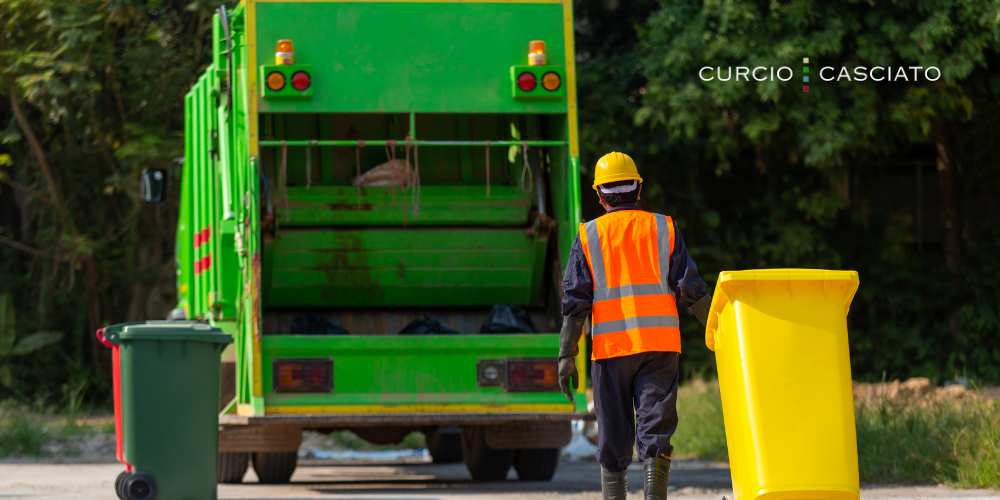
Garbage truck crash cases typically involve multiple parties. These may include the business controlling operations, the City of Chicago, a national waste management company, or a smaller independent garbage truck company or hauler. These are the defendants with the insurance coverage and assets to compensate plaintiffs for serious injuries and family members for wrongful death.
However, other parties, called third-party vendors, can also be held responsible. Common examples include maintenance providers, manufacturers and parts suppliers, repair contractors, construction site owners, other drivers, etc.
Identifying appropriate parties is generally why families consult a Chicago garbage truck accident lawyer. Additionally, public-entity defendants trigger different rules and shorter filing deadlines. This makes determining liability and identifying all responsible parties quickly crucial.
At-Fault Party | Typical Negligence | Who Ultimately Pays |
|---|---|---|
City of Chicago / municipality | Negligent operation by a government employee; inadequate maintenance | The municipality (subject to Tort Immunity Act limits & shorter deadline) |
Private waste management company or trucking company | Garbage truck driver’s employer has vicarious liability for driver error, negligent hiring, training, or maintaining the fleet | The waste management or trucking company and its commercial insurance company |
Independent or local hauler | Driver negligence; deferred maintenance; inadequate training | The hauler and its insurer (often lower policy limits) |
Truck driver | Distracted driving, fatigued driving, speeding, reckless driving, blind-spot and backing errors, impairment, etc. | The driver’s employer or personal insurance coverage, depending on classification |
Parts manufacturer | Defective brakes, hydraulics, or safety components | The company is responsible under product liability |
Maintenance provider | Negligent repair or inspection | The maintenance company and its insurance company |
The City of Chicago & Municipal Haulers
The Chicago Department of Streets and Sanitation collects residential waste using government-owned trucks and city employees. Garbage truck accident claims against the City of Chicago are governed by the Illinois Tort Immunity Act. This shortens the deadline for filing a personal injury lawsuit and creates other procedural hurdles that don’t apply to private waste management companies or trucking companies.
Victims hit by a city waste management truck need to understand the rules for suing a government entity in Chicago. Contact a Chicago garbage truck injury lawyer to discuss the legal process.
Private Waste Management Companies
Most commercial and suburban routes are operated by private waste management companies. A Chicago garbage truck accident attorney can pursue these companies both for the garbage truck driver’s negligence, under vicarious liability, and for their own failures in hiring, training, supervising, and maintaining the vehicle. Major private waste management companies in the Chicago area include:
- Waste Management of Illinois
- Republic Services
- Lakeshore Recycling Systems
- Flood Brothers Disposal
- Groot Industries
Independent & Local Scavenger Companies
Smaller independent and “scavenger” haulers also operate throughout Chicago and the collar counties. These operators often carry lower insurance coverage than national trucking companies. This makes early investigation and sending spoilation letters to preserve crucial evidence particularly important. Lower insurance policies may need to be supplemented by other parties. Independent operators in the region include:
- Chicago Disposal, Inc.
- SBC Waste Solutions
- Auburn Disposal
- Tri-State Disposal
- Roy Strom Refuse Removal
- D&P Construction
Manufacturer, Maintenance Company & Truck Driver Negligence
Three additional negligent parties can also be held responsible. The garbage truck driver may be the responsible party if they were engaged in distracted driving, fatigued driving, driving over the speed limit, driving under the influence, failing to check blind spots, or other driver errors. The parts maker may be the responsible party if defective brakes, hydraulics, or safety equipment contributed to the truck crash. While many cases involve multiple liable parties, these fall under product liability claims. Additionally, maintenance companies may be the responsible party if negligent repair or inspection is a contributing factor in the crash. These same principles apply to accidents involving semi-trucks or other commercial vehicle accident claims in Chicago .
Legal Representation For Injured Sanitation Workers & Garbage Truck Drivers in Chicago
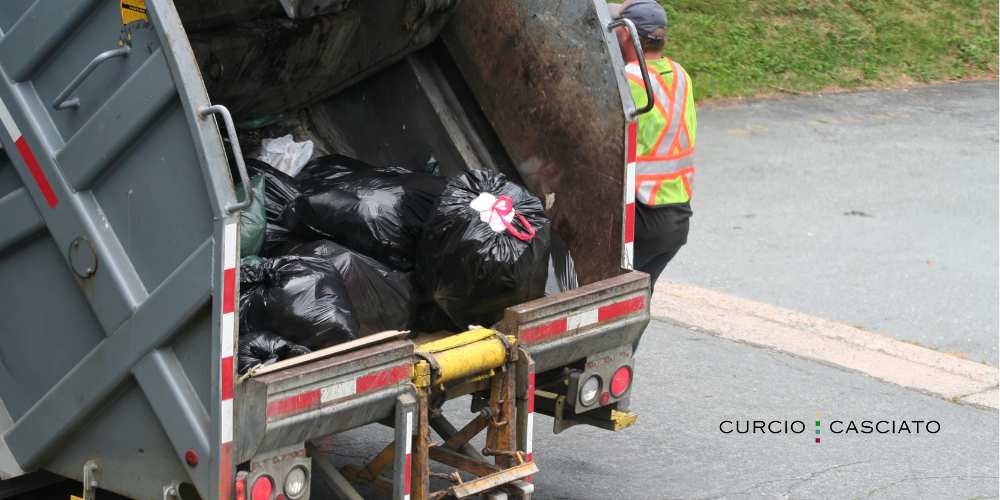
Refuse collection is the country’s fifth-deadliest job. According to FMCSA reports, there are ~4,400 to 6,000 dump truck accident injuries annually and 1,200 to 1,500 refuse/garbage truck accidents a year. Trash collectors have a fatality rate of 37.4 deaths per 100,000 workers, over 11x the national average, according to the Bureau of Labor Statistics. Transportation incidents remain the leading cause of waste management on-the-job deaths.
Injured sanitation workers and garbage truck drivers normally have two recovery paths. A Chicago garbage truck accident attorney from our law firm can help injured drivers pursue compensation through both types of legal processes when applicable:
- Illinois workers’ compensation is against the employer, which pays medical bills and a portion of lost wages regardless of fault.
- A third-party worker injury claim against a separate at-fault party, including the other driver, an equipment manufacturer, a construction site owner, a government entity, ot other negligent party. These claims can recover damages that workers’ compensation doesn’t, including pain and suffering and the full extent of lost wages.
Compensation for Dump Truck & Garbage Truck Accident Victims in Chicago, IL
Illinois law lets injured victims recover both economic damages, the concrete, out-of-pocket costs of a crash, and non-economic damages, which provide recovery for the human toll, like pain and suffering. In fatal crashes, surviving family members may also bring a claim through a Chicago fatal auto accident attorney. If the attorney can prove gross negligence, plaintiffs can also seek punitive damages.
Victims can seek compensation for the following and more:
Economic Damages | Non-Economic Damages |
|---|---|
Past medical bills & future medical expenses | Pain and suffering |
Lost income & diminished earning capacity | Disability & disfigurement |
Rehabilitation & long-term medical treatment | Loss of a normal life |
Assistive devices & home modification | Emotional distress |
Property damage | Loss of consortium |
Illinois follows a comparative fault statute. This modified comparative negligence means that the injured person can recover damages as long as they’re not over 50% responsible. Their recovery is reduced by their percentage of fault.
Settlement
$30,000,000
A mother and daughter struck in a crosswalk by a commercial vehicle.
Verdict
$18,150,000
Teen struck by a truck.
Partial settlement
$9,125,000
Wrongful death, Central District of Illinois.
Partial settlement
$8,000,000
Semi-truck accident.
Settlement
$7,000,000
Woman struck in a crosswalk by a commercial vehicle.
Settlement
$4,800,000
Truck driver killed at a truck stop.
Verdict
$2,130,000
Truck accident.
Past results do not guarantee a similar outcome in any future case.
See more of our garbage truck accident lawyers’ motor vehicle recoveries.
State and Federal Regulations for Garbage Truck Accident Cases
Illinois Laws Governing Garbage Truck Crashes
The deadline for filing a garbage truck accident claim in Chicago is that your time limit depends on who you’re suing. If you’re suing a private hauler, waste management company, or driver, the standard two-year Illinois personal injury statute of limitations applies. If you’re suing the City of Chicago or another government entity, the deadline is one year, with earlier notice requirements in many cases. Some are as little as 90 days.
If a child is injured in an accident in Chicago, the law typically allows exceptions to filing deadlines.
However, most people don’t know whether a garbage truck is publicly or privately owned, or if street issues were contributing factors. Victims should seek legal representation from a Chicago garbage truck accident attorney as soon as possible.
Weight Limits & Equipment Regulations
- Axle weight rules: Illinois transport law sets axle-load weight maximums and single-axle exceptions for specialized front-loading garbage trucks and recycling compactors.
- Tarp and debris enforcement: State law requires commercial haulers to secure and cover loose refuse.
Evidence & Liability Standards
- Private vs. public liability: Private waste management companies are held to ordinary corporate negligence standards, while government entities involve immunity caps and stricter legal processes
- Critical evidence preservation: Telematics, GPS, route sheets, and maintenance records must be requested immediately. Black box data is often overwritten within a few days.
Key Federal Regulations for Garbage Truck Accident Claims
- Hours of Service (HOS): Strict driving limits to prevent fatigue-related crashes.
- Commercial Driver’s License (CDL): Truck driver qualifications include holding a valid CDL, passing regular medical exams, and maintaining clean driving records.
- Drug and alcohol testing: Garbage truck drivers must undergo pre-employment, random, and post-accident screening.
- Inspection and maintenance: Detailed daily inspection, repair, and maintenance records must show that brakes, lights, and steering were safe.
- OSHA regulations: Workplace protections covering general vehicle hazards and truck operations.
- EPA standards: Federal guidance on solid waste storage, hazardous materials, container safety, and vehicle containment.
- Minimum insurance limits: Federal law requires commercial trucks to carry far higher liability coverage (often $750,000 to $5 million or more) than passenger cars.
The Federal Exemption “Catch” for Trucks Operated by Government Entities
The main “catch” for garbage truck accidents in Chicago: federal DOT regulations generally do not apply to government-run vehicles. When government entities own municipal trash collection, their garbage truck drivers and other employees are often exempt from federal hours-of-service and maintenance rules. Here, only Illinois state vehicle codes and local municipal safety policies govern the standard of care.
This is why our garbage truck accident lawyers work to identify all responsible parties to help clients seek fair compensation.
Handling Waste Management Accident Injuries Across North Illinois
Helping garbage truck accident victims across Illinois.
We take on government entities, corporate legal teams, & insurance adjusters in all 102 counties.
- COOK CO
- DUPAGE CO
- WILL CO
- KANKAKEE CO
- LAKE CO
- KANE CO
- MADISON CO
- ST. CLAIR CO
- WINNEBAGO CO
- SANGAMON CO
- ROCK ISLAND CO
- Northwestern Memorial Hospital
- University of Chicago Medical Center
How Our Chicago Garbage Truck Accident Lawyers Can Help
Our law firm’s Chicago garbage truck accident lawyer team preserves the critical evidence these personal injury claims need. We determine liability and pursue compensation from every negligent party, navigating the special rules that government entity claims require. Because fleet data is quickly deleted and municipal deadlines are short, having a Chicago garbage truck accident lawyer involved early can be the difference between recovering maximum compensation and losing your right to seek compensation entirely.
Our waste management accident attorneys work quickly to secure evidence such as:
- Truck telematics, GPS, & “black box” data
- Driver logs, hours-of-service records, & CDL history
- Route sheets & dispatch records
- Inspection & maintenance records
- Dashcam & potential surveillance footage
- Witness statements, police reports & medical records
If you’ve been involved in a garbage truck accident in Chicago, the following steps can help protect your personal injury claim:
- Call 911 and seek medical attention immediately
- Report the crash and get an accident report number
- Photograph the truck, its markings/company name, the scene, and your injuries
- Get contact information for the driver and any witnesses
- Avoid giving a recorded statement to an insurance adjuster before speaking with an attorney
- Contact a lawyer immediately if you’re injured, or your vehicle sustained extensive damage
Our garbage truck accident attorneys in Chicago handle claims on a contingency-fee basis. Clients don’t owe anything unless we recover compensation. Our law firm has represented injured Chicagoans since 1957.
Whether you’ve been injured as a worker, the other driver, or the case involves construction and work-zone accidents in Chicago, our attorneys can help you take legal action.
Chicago Dump Truck & Garbage Truck Accident FAQs
Are garbage trucks liable for damages?
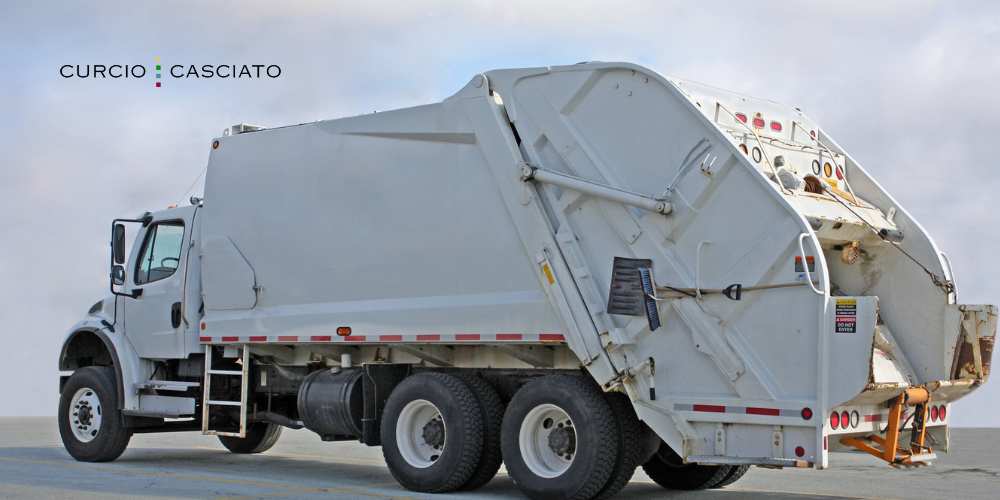
Yes, when a garbage truck driver, their employer, or manufacturer causes or contributes to a crash, they can be held liable and forced to pay for the victim’s losses. Liability follows fault. So, the case focuses on who is the responsible party for the crash.
In Illinois garbage truck accidents, if a:
- private waste management company operated the truck; the standard two-year deadline usually applies.
- government entity operated it, shorter deadlines and notice requirements apply.
How much is a dump truck accident claim worth in Chicago?
There isn’t a set settlement amount for Chicago dump truck accident claims. The case’s value depends on the injury’s severity, the cost of medical bills and future medical expenses, lost income and future earning capacity, and the plaintiff’s degree of fault. Dump truck accident lawsuits involving catastrophic injuries like traumatic brain injury or paralysis have the potential for significantly higher settlements because of future medical treatment and earning capacity losses.
Who pays if a City of Chicago garbage truck hits me?
If a garbage truck is owned by a government entity or a city employee causes the crash, the personal injury claim is against the City of Chicago. The Illinois Tort Immunity Act governs these garbage truck accident claims, imposing shorter filing deadlines and applying specific additional rules.
It’s crucial to seek legal counsel quickly. You must take legal action within a year of the accident.
What should I do immediately after a garbage truck accident?
Immediately after a garbage truck accident in Chicago, seek medical care, call the police, and have a friend or family member photograph the truck including the company name), the scene, and your injuries, and collect witness contact information.
Avoid giving a recorded statement to any insurance adjuster, and contact a Chicago garbage truck accident attorney from our law firm. Call 312-321-1111 for a free consultation.
Do I need a garbage truck accident lawyer for an insurance claim in Cook County?
If you only suffered minor injuries, you may be able to negotiate a fair settlement agreement with the insurance company yourself. However, dump truck accident and garbage truck accident cases usually involve multiple parties, corporate legal teams, commercial trucking insurance adjusters, and strict legal processes. When city garbage truck accidents occur, additional rules apply. A Chicago garbage truck accident lawyer can identify responsible parties, preserve fleet evidence, and protect filing deadlines that unrepresented victims miss.