
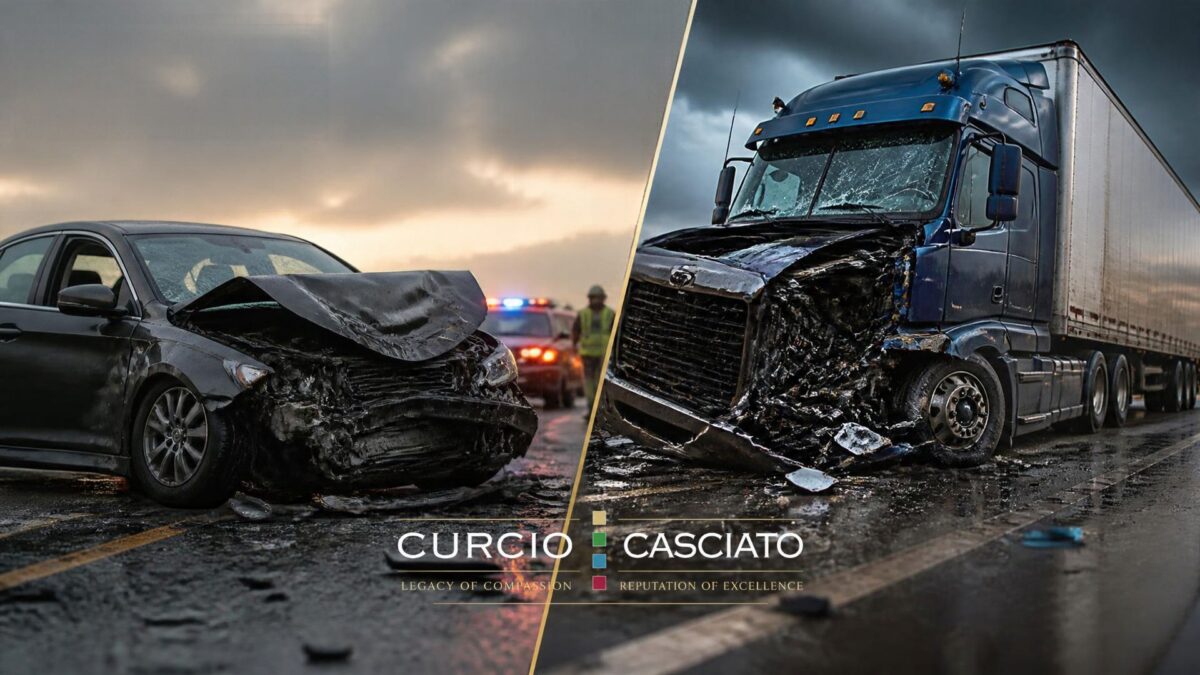
Commercial truck accident cases differ from ordinary car accident cases because trucking companies and drivers must follow additional federal safety regulations, commercial trucks generate extensive electronic and business records, and responsibility for a crash may extend beyond the driver. Serious trucking cases often require immediate investigation of the driver, truck, motor carrier, maintenance history, electronic records, corporate relationships, and other evidence.
A collision involving an 80,000-pound tractor-trailer on I-90/94, I-55, I-290, or the Tri-State Tollway may look like an unusually serious automobile accident.
Legally and practically, however, a commercial trucking case can be very different.
Commercial drivers and motor carriers operate under federal safety regulations that do not apply to ordinary motorists. Trucks may contain electronic information that can help reconstruct what happened. Motor carriers maintain driver, inspection, maintenance, dispatch, and other records that can become important evidence. Depending on why a crash occurred, investigating responsibility may require looking beyond the driver to the motor carrier and potentially other companies involved in operating, maintaining, loading, or controlling the vehicle.
Curcio & Casciato attorneys have litigated serious commercial trucking cases in Illinois for years, including cases involving accident reconstruction, commercial-vehicle inspections, braking and maintenance issues, federal trucking regulations, disputed eyewitness testimony, driver and motor-carrier responsibility, and complex corporate relationships.
Our experience has taught us an important lesson:
A serious truck accident case should not be investigated as simply a bigger car accident.
What Makes a Commercial Truck Accident Case Different From a Car Accident Case?
There are several important differences.
- Interstate commercial trucking is subject to the Federal Motor Carrier Safety Regulations (FMCSRs), which establish safety requirements governing drivers and motor carriers.
- A commercial trucking operation can generate significantly more evidence than an ordinary passenger vehicle, including electronic logging records, vehicle data, inspection and maintenance records, driver qualification materials, dispatch communications, and other business records.
- The driver may not be the only person or company whose conduct requires investigation.
- Commercial trucking companies and their insurers understand the potential consequences of catastrophic crashes. Serious cases can begin developing almost immediately after the collision.
That makes knowing what evidence to look for, where to find it, and how to preserve it particularly important.
What Federal Regulations Apply to Commercial Trucks?
Commercial truck drivers follow the same basic traffic laws as other motorists, but many drivers and motor carriers also follow additional federal safety regulations administered by the Federal Motor Carrier Safety Administration.
The FMCSRs address subjects including:
- hours of service;
- driver qualifications;
- commercial driver’s licenses;
- drug and alcohol testing;
- vehicle inspection, repair, and maintenance;
- cargo securement; and
- recordkeeping and other motor-carrier safety obligations.
Which regulations apply depends upon the driver, carrier, vehicle, cargo, and nature of the transportation involved.
In a serious trucking case, identifying the applicable regulations is only the beginning. The next question is whether the evidence shows that the driver or carrier complied with them and whether any violation actually contributed to the collision.
How Many Hours Can a Commercial Truck Driver Legally Drive?
Driver fatigue has long been a significant focus of federal trucking regulation.
Under current federal truck driver hours-of-service rules, most property-carrying commercial drivers may drive for up to 11 hours after 10 consecutive hours off duty. That driving must generally occur within a 14-consecutive-hour driving window after coming on duty.
Additional rules govern required breaks and the total number of hours a driver may remain on duty over seven- and eight-day periods.
But investigating fatigue involves more than asking a driver how long he or she had been driving.
Depending upon the circumstances, attorneys may need to compare electronic logging information with dispatch records, delivery schedules, GPS or telematics information, receipts, bills of lading, and other available records.
The objective is not simply to find a technical violation.
The goal is to determine what the driver was doing before the crash, how long the driver had been working, and whether fatigue or scheduling pressure played any role.
What Is a Commercial Truck’s “Black Box”?
People often use the term “black box” to describe electronic information stored by a commercial truck’s engine or vehicle systems.
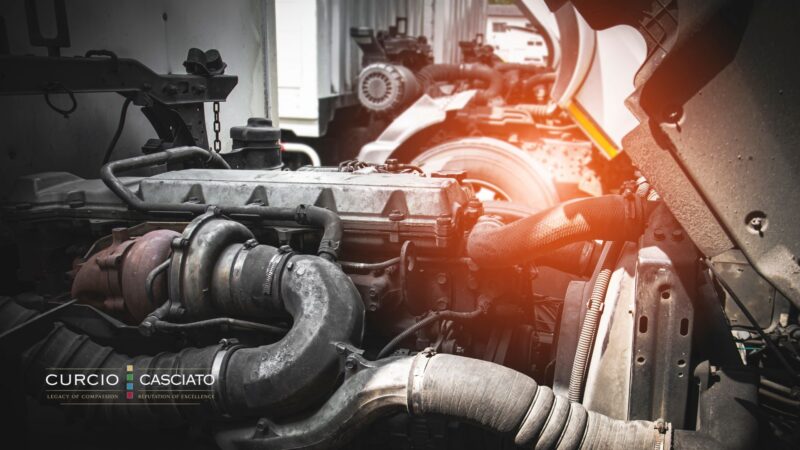
Depending on the truck and its equipment, an electronic control module or related system may contain information useful for reconstructing a collision, including vehicle speed, engine activity, braking-related information, throttle inputs, or other operational data.
But no single universal “truck black box” records the same information in every commercial vehicle.
The truck’s manufacturer, engine, electronic systems, configuration, and the circumstances of the crash can affect what information exists and what investigators can recover.
That is why a serious truck crash investigation should not simply request “the black box.”
The investigation should determine which electronic systems were installed on the vehicle, what information they recorded, and how that information can be properly preserved and analyzed.
What Is the Difference Between Black Box Data & an Electronic Logging Device?
They are not the same thing.
A truck’s electronic control module or other vehicle systems may contain information about the truck’s operation.
An electronic logging device, or ELD, primarily records a commercial driver’s duty status for federal hours-of-service compliance.
That distinction matters.
If the question is how fast a truck was traveling or how the vehicle was operating around the time of a collision, vehicle or engine data may be important.
If the question is whether the driver exceeded permissible driving or on-duty hours, the ELD and supporting records may become important.
A thorough investigation may require both.
What Evidence Should Be Investigated After a Serious Truck Crash?
The evidence needed depends upon how the crash occurred.
Potential evidence in a commercial trucking case may include:
- the tractor and trailer;
- available electronic vehicle or engine data;
- ELD records and supporting hours-of-service documentation;
- driver qualification records;
- inspection, repair, and maintenance records;
- pre-trip and post-trip inspection information;
- dispatch communications;
- GPS and telematics information;
- onboard video, if available;
- bills of lading and shipping records;
- photographs and measurements of the scene and vehicles;
- police and governmental inspection records;
- eyewitness testimony;
- drug and alcohol testing information when applicable;
- motor-carrier safety policies and records; and
- contracts and corporate records identifying the relationships among companies involved in the transportation.
Not every case requires every category of evidence.
The important question is why the crash occurred. The investigation should then follow the evidence needed to answer that question.
Why Truck Inspection & Maintenance Evidence Can Matter In Illinois Personal Injury Claims
Federal regulations impose inspection, repair, and maintenance obligations on motor carriers and commercial vehicles.
When a crash raises a question about brakes, tires, steering, lighting, or another mechanical system, inspecting the commercial vehicle and obtaining its maintenance history can become critical.
Curcio & Casciato’s experience demonstrates why.
A $30 Million Commercial Truck Settlement Involving Brake & Reconstruction Evidence
In one confidential Chicago commercial trucking case, Curcio & Casciato attorneys represented people catastrophically injured when a commercial truck struck pedestrians.
The investigation went far beyond the driver’s account.
Police investigators documented and mapped the scene. Multiple eyewitnesses described the collision. The plaintiffs retained an accident-reconstruction expert to evaluate those accounts against the physical evidence.
Investigators also inspected the commercial truck.
An Illinois State Police inspection performed after the collision identified multiple braking problems. The plaintiffs’ reconstruction expert analyzed the truck’s braking system and concluded that the available braking capacity had been substantially reduced.
The litigation therefore required the Chicago commercial truck accident attorneys to combine eyewitness testimony, physical evidence, police reconstruction, commercial-vehicle inspection findings, expert analysis, and federal trucking safety requirements to build the liability case.
The case ultimately resolved for $30 million.
The lesson from that case extends beyond the result: when a commercial truck’s mechanical condition may have contributed to a crash, investigating the vehicle can be as important as investigating the driver.
Why Accident Reconstruction Can Be Important in Illinois Trucking Accident Claims
Witnesses can be extremely important after a collision, but eyewitness testimony does not always tell the entire story.
People observe accidents from different locations and perspectives. Serious collisions happen quickly. Witnesses may disagree about speed, distance, vehicle movements, traffic signals, or the sequence of events.
Commercial truck cases may therefore require comparing witness recollections with objective evidence.
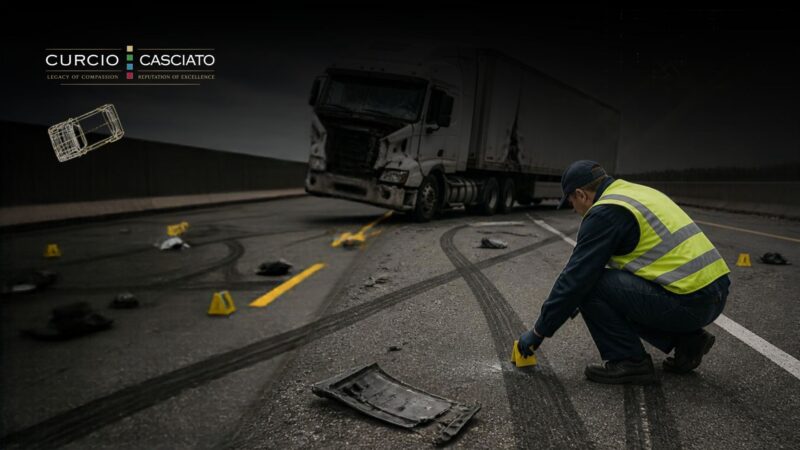
Depending upon the case, accident reconstruction can incorporate:
- scene measurements;
- vehicle damage;
- photographs;
- roadway evidence;
- electronic vehicle information;
- braking and mechanical evidence;
- vehicle weights and dimensions;
- sight distances;
- video; and
- other physical evidence.
The purpose is not to select whichever witness account helps one side.
It is to determine whether the available evidence can establish how the collision physically occurred.
That distinction mattered in our $30 million trucking case, where we evaluated competing eyewitness accounts against physical evidence, police investigation, vehicle inspection findings, and expert reconstruction.
Who Can Be Responsible for a Commercial Truck Crash? – Potentially Multiple Defendants
The truck driver is an obvious starting point, but the investigation does not necessarily end there.
Depending upon the circumstances, potentially relevant people or entities may include:
- the commercial driver;
- the motor carrier;
- an owner or lessor of the tractor or trailer;
- a company responsible for inspection or maintenance;
- a company responsible for loading or securing cargo; or
- other entities whose conduct actually contributed to the collision.
But an important qualification is often overlooked:
Simply transporting freight does not automatically make a company legally responsible for a crash.
Determining responsibility may require examining who employed the driver, who controlled the driver’s work, who owned and maintained the equipment, who loaded the cargo, what each company agreed to do, and what role each entity actually played.
Curcio & Casciato attorneys have litigated those questions through trial and appeal.
When Can a Shipper Be Responsible for a Truck Driver’s Conduct?
A trucking case litigated by Founding Partner Jack J. Casciato produced a published Illinois Appellate Court decision addressing that question.
A jury assessed $18,150,750 in damages in a commercial trucking case involving a driver, motor carrier, and shipper. The litigation included a dispute over whether the shipper exercised enough control over the motor carrier and driver to create an agency relationship.
The evidence examined subjects including communications concerning loads, delivery requirements, cargo security, insurance requirements, driver qualifications, safety ratings, equipment, and the contractual relationship between the companies.
The Illinois Appellate Court ultimately concluded that the evidence was insufficient to establish that the motor carrier and driver were the shipper’s agents. It therefore reversed the judgment against the shipper.
Importantly, the appellate court expressly stated that its decision did not affect the judgment against the driver and motor carrier, who were not parties to that appeal.
Jack Casciato represented the plaintiff at trial and was among the attorneys representing the plaintiff in the appeal. The case illustrates why identifying multiple companies connected to a shipment is not enough.
The legal analysis requires determining what each company actually controlled and whether the evidence supports holding that particular entity responsible under Illinois law.
What Determines Whether a Motor Carrier or Another Company Controlled a Driver?
Control can be critical in determining whether an agency relationship exists.
In the published Illinois appellate decision involving our client, the court examined evidence of who controlled matters such as the driver’s hours, routes, equipment, compensation, hiring and firing, and how the transportation work was performed.
Although the shipper imposed various requirements relating to the freight and delivery process, the appellate court concluded that those requirements did not establish the degree of control necessary to make the driver and carrier the shipper’s agents.
That distinction shows why commercial trucking litigation requires careful examination of contracts and actual business practices.
A contract’s label matters, but the investigation may also need to determine how the companies actually operated.
Why Corporate Relationships Can Matter in Trucking Litigation
The name painted on the side of a truck does not necessarily identify every company relevant to the investigation.
One company may own the tractor while another operates it. A trailer may be leased. A shipper may contract with a carrier. Other companies may perform maintenance, loading, dispatching, or other services.
That does not mean we should sue every company. It means we should understand the relationships.
In our $30 million confidential trucking matter, the litigation included investigation of the corporate relationships among entities associated with the commercial vehicle and financial resources potentially available to compensate our clients.
In the published appellate case, the relationship between a shipper and motor carrier became a central legal issue and ultimately resulted in a published Illinois decision concerning agency and control.
Those experiences reinforce the same principle:
Follow the evidence first. Determine responsibility second.
Why Early Investigation Matters After a Serious Truck Crash in Illinois
Commercial trucking evidence can be spread among multiple sources.
The truck may need inspection. Electronic information may need to be identified and preserved. Video may exist. Witnesses need to be located. You may need to request or preserve evidence, such as maintenance records, ELD information, dispatch communications, and other business records.
Some federal records have specific retention requirements. Other evidence may be retained for different periods or may change through ordinary business operations.
For that reason, serious trucking cases can benefit from prompt preservation efforts focused on the evidence that may matter in the particular crash.
The objective is not simply to send a generic letter demanding that a trucking company “preserve everything.”
The goal is to understand enough about the collision and trucking operation to identify what evidence likely exists and why it could matter.
How Is a Truck Accident Investigation Different From a Car Accident Investigation?
A serious car accident can require reconstruction, electronic evidence, experts, and a thorough investigation.
The difference in trucking cases is the additional information that may exist because the vehicle is part of a regulated commercial operation.
A trucking investigation may require answering questions such as:
- Was the driver qualified to operate the vehicle?
- How long had the driver been working?
- What did the ELD and supporting records show?
- What condition were the brakes, tires, and other safety systems in?
- When was the truck last inspected or repaired?
- What electronic information did the truck record?
- Who owned and maintained the tractor and trailer?
- Who employed and controlled the driver?
- What companies were involved in moving the freight?
- What do the contracts say, and how did the companies actually operate?
- Does the physical evidence support the driver’s and witnesses’ accounts?
Those questions generally don’t arise in an ordinary two-car collision.
Curcio & Casciato’s Experience Litigating Commercial Truck Cases
Curcio & Casciato attorneys have litigated serious commercial trucking cases in Illinois over many years.
Our experience includes confidential trucking matters that resolved for $30 million, $9.125 million, and $800,000, as well as a commercial trucking case in which a jury assessed more than $18 million in damages and the resulting litigation produced a published Illinois Appellate Court decision concerning agency and control.
More important than the amounts, however, is the work those cases have required.
Our trucking litigation experience has involved issues including:
- accident reconstruction;
- commercial vehicle inspections;
- braking and maintenance evidence;
- federal motor-carrier safety requirements;
- disputed eyewitness testimony;
- driver and motor-carrier responsibility;
- corporate relationships;
- agency and control;
- insurance and financial-responsibility issues; and
- catastrophic injuries and damages.
That experience shapes how we investigate new commercial trucking cases.
No two truck crashes are identical, and the investigation should follow the facts rather than a predetermined checklist of defendants or theories.
Frequently Asked Questions About Illinois Truck Accident Cases
Are truck accident cases different from car accident cases?
Yes, truck accident cases are different from car accident cases. Commercial trucking cases can involve federal motor-carrier safety regulations, driver qualification requirements, hours-of-service records, commercial vehicle inspection and maintenance records, electronic information, and relationships among multiple companies that generally are not present in an ordinary automobile accident.
What is a truck’s black box?
A truck’s “black box” data is an informal term often used for electronic information stored by a truck’s engine or vehicle systems. Depending on the vehicle, available data may show how the truck was operating before or during a crash.
Is an ELD the same as a truck’s black box?
No, an ELD, or electronic logging device, isn’t the same as a truck’s black box. An ELD primarily records information related to a commercial driver’s record of duty status and hours-of-service compliance. Vehicle or engine electronic systems may contain different information about the truck’s operation.
Can a trucking company be responsible for its driver’s crash?
Yes, a trucking company can potentially be responsible for its driver’s crash. The answer depends upon the driver’s relationship with the motor carrier, the circumstances of the collision, applicable state and federal law, and the theories supported by the evidence.
Can a shipper or freight broker be liable for a truck accident?
Yes, a shipper or freight broker can potentially be liable for a truck accident. However, arranging or shipping freight does not by itself establish liability. The legal analysis may depend upon the entity’s role, its relationship with the motor carrier and driver, the degree of control it exercised, its own conduct, applicable contracts, and other facts.
Why are maintenance records important after a truck accident?
Maintenance records are important after a truck accident because, if mechanical failure or the truck’s condition contributed to a collision, inspection and maintenance records may help establish the vehicle’s condition, what maintenance was performed, whether problems were previously identified, and who was responsible for maintaining the equipment.
How quickly should a serious truck accident be investigated?
A serious truck accident should be investigated as soon as reasonably possible. Different records and electronic information can be subject to different retention practices and legal requirements, and physical evidence can change over time.
Trucking Cases Require More Than Knowing the Traffic Laws
The size and weight of commercial trucks make serious collisions potentially devastating. But trucking litigation is more than physics.
Commercial transportation operates within a network of federal safety regulations, drivers, motor carriers, equipment, electronic records, maintenance requirements, contracts, and corporate relationships.
Understanding that network can be essential to understanding why a crash occurred and who should legally be held responsible.
Curcio & Casciato’s attorneys have investigated, litigated, tried, and appealed serious commercial trucking cases in Illinois. Our experience includes cases requiring detailed investigation of vehicle condition, braking systems, federal regulations, eyewitness testimony, accident reconstruction, motor-carrier practices, and corporate relationships in the aftermath of:
- Delivery vehicle claims, such as Amazon truck accidents, UPS truck accidents, and USPS mail truck accidents
- Construction truck accidents
- Garbage and dump truck accidents
- Tanker accidents
- Tractor-trailer and semi-truck accidents in Cook County.
When someone suffers catastrophic injuries or a family loses a loved one in a commercial truck collision, our objective is not simply to identify the truck driver.
Our objective is to determine what happened, why it happened, what evidence proves it, and which people or companies the law holds responsible.
This article is intended for general informational purposes only and does not constitute legal advice. Federal and state trucking laws and regulations are complex and may change. Every case depends upon its particular facts and applicable law.